Newsletter Subscribe
Enter your email address below and subscribe to our newsletter

 ByJohn A
Virtual reality in education is moving from novelty to a scalable tool. It supports authentic, context-rich exploration with structured tasks and immediate feedback. In K–12 and higher education, VR aligns with clear objectives, while addressing equity and privacy concerns. Educators choose hardware and content to fit goals, pilot with metrics, and blend VR with traditional methods to boost retention and transfer. The approach raises practical questions about implementation, funding, and evaluation that deserve careful consideration.
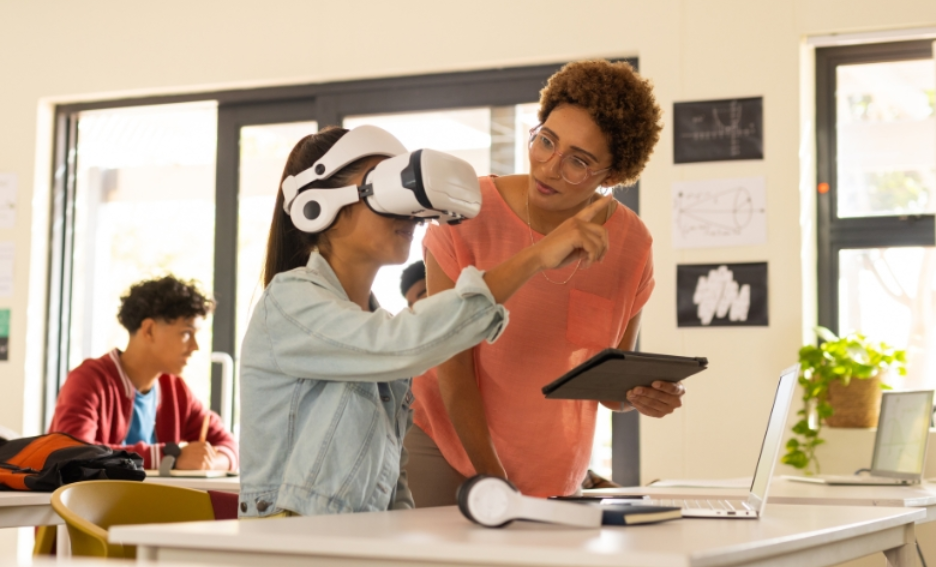
Virtual reality in education today is increasingly integrated across K–12 and higher education, transitioning from novelty to a practical tool for deepening understanding.
Programs emphasize VR hardware selection, streamlined classroom engagement, and scalable immersive simulations to align with learning objectives.
Evidence-based deployments address budget considerations, teacher training, and accessibility, revealing a pragmatic landscape where students experience authentic contexts while instructors measure outcomes with clarity and consistency.
VR supports deep learning by immersing students in controlled, authentic contexts that are difficult to replicate in traditional classrooms. This approach emphasizes structured exploration, feedback loops, and cognitive anchoring, enabling transfer across tasks. Evidence points to improved retention and transfer when immersion strategies align with learning goals. Attention to accessibility challenges ensures equitable participation and meaningful outcomes for diverse learners.
Real-world classrooms demonstrate how immersive technology translates to subject-specific practice, from science labs to language arts, by providing authentic, context-rich experiences that supplement traditional instruction.
VR scenarios illustrate augmented inquiry, from biology simulations to historical reconstructions, enabling comparative analysis and skill transfer.
Institutions navigate innovation challenges and ethical considerations, balancing access, data privacy, and equitable participation while preserving instructional clarity and learner autonomy.
Implementing virtual reality in schools begins with clear goals, careful selection of hardware and content, and a structured rollout plan that minimizes disruption to existing curricula.
Schools should assess needs, align with learning objectives, and pilot with defined success Metrics.
VR budgeting and VR hardware choice influence procurement, training, and maintenance, ensuring scalable adoption while preserving instructional autonomy and evidence-based outcomes.
Costs vary; districts should plan for hardware procurement and ongoing maintenance. The answer emphasizes cost budgeting, upfront devices, software licenses, peripherals, professional development, and potential subscriptions, with evidence-based budgeting guiding scalable, flexible VR deployments for autonomy and choice.
Guided by caution, the answer focuses on student wellbeing and data privacy, outlining risk mitigation, supervision, and clear consent; it uses one metaphor to engage readers, stressing practical, evidence-based safety protocols in VR sessions.
Teacher training for effective VR use emphasizes VR pedagogy, ongoing assessment, and risk-aware facilitation. Schools should provide structured, evidence-based programs, peer collaboration, and hands-on practice to build confident, adaptable instructors who integrate immersive tools responsibly.
A notable 78% of programs align VR assessments with measurable competencies, while AR comparison highlights variance across curricula. VR ethics considerations shape rubrics, ensuring safety and inclusivity; assessments emphasize evidence-based outcomes rather than tech novelty, fostering practical, learner-centered validation.
Effectiveness is measured through practical assessments and performance gains; measure effectiveness by comparing pre- and post-tests, task accuracy, and transfer. Identify benchmarks across domains, engagement, and retention to determine robust learning outcomes and applicable instructional gains.
In the end, VR in education functions as a scalable, evidence-led enhancer rather than a gimmick. A district that piloted VR science modules reported a 12-point uptick in assessment scores and higher engagement from diverse learners. Like a calibrated microscope, VR sharpens focus on core objectives while revealing unseen connections across topics. When paired with traditional instruction and strong privacy practices, VR becomes a practical bridge from curiosity to mastery, not a substitute for foundational teaching.